Xi Jinping’s Tech Crusade: Why China Is Betting Its Future on Science, Not Ideology
Xi Jinping’s first 2026 inspection tour sends a blunt message: China’s global ambitions now hinge on science, technology, and innovation, not slogans or ideology.
 Ronald
Advertisement
Xi Jinping’s decision to begin 2026 not with a symbolic rural visit or ideological showcase, but with a tour of Beijing’s technology nerve center, was not accidental, and it was not subtle either. It was a statement of intent delivered in steel and silicon rather than speeches and banners. In modern China, power no longer begins with party slogans or historical nostalgia, it begins with code, laboratories, chips, and industrial ecosystems capable of surviving a hostile global environment.
Advertisement
Advertisement
Advertisement
Advertisement
Beijing E-Town, the site of Xi’s first inspection of the year, is not just another development zone, it is China’s prototype of the future state, a tightly engineered fusion of government direction, private capital, military-grade research, and algorithmic ambition. By choosing this location, Xi effectively told the world that the next phase of Chinese governance will be written in technological terms, not purely political ones.
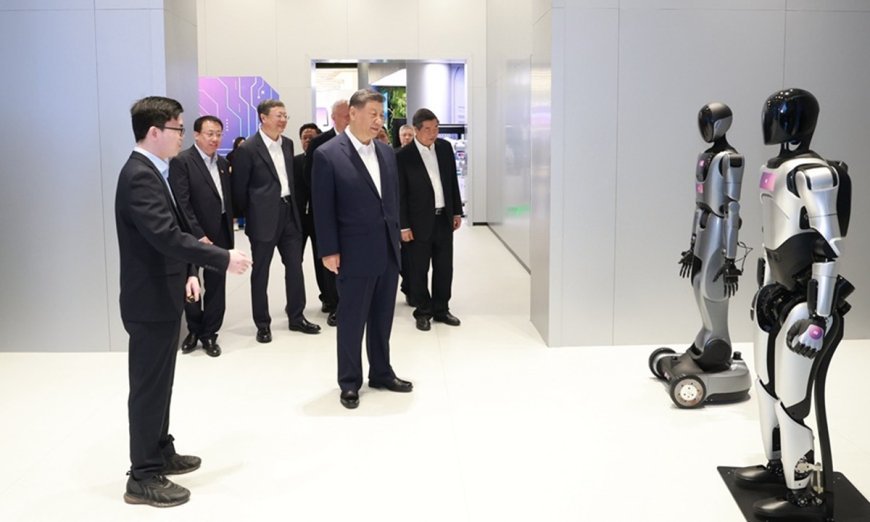
The language Xi used was revealing. He did not speak of cooperation or openness, but of “self-reliance”, “core technologies”, and “national resource mobilization”, phrases that belong more to wartime economies than peaceful globalization. This is the vocabulary of a country that no longer believes the international system will remain friendly or fair, and is therefore preparing to survive, and dominate, on its own terms.
China ranking tenth in the Global Innovation Index is not just a statistic, it is a psychological milestone. For decades, China was dismissed as a manufacturing giant but an innovation dwarf, capable of copying but not creating, assembling but not inventing. That narrative is now collapsing under the weight of its own irrelevance, replaced by a far more uncomfortable reality for the West, which is that China is no longer chasing technological leadership, it is actively constructing it.
Xi’s emphasis on artificial intelligence, humanoid robotics, and high-tech manufacturing fits neatly into a broader strategy that is becoming increasingly clear: China is engineering a future in which economic power, military leverage, and political influence all flow from technological supremacy. This is not Silicon Valley’s version of innovation, driven by chaotic startups and private risk, but a centralized, state-coordinated model where national objectives override market logic.
The Central Economic Work Conference’s plan to build multiple global tech hubs across Beijing, Shanghai, and the Greater Bay Area reinforces the same message, that China is not experimenting anymore, it is scaling a fully industrialized innovation machine. These cities are not being positioned as regional players, but as rival ecosystems to Silicon Valley, Tokyo, and Berlin combined.
What makes this shift more unsettling is how openly strategic it has become. Xi is no longer pretending that technology is just about economic growth or consumer convenience, he is framing it as the core battlefield of national survival. This is innovation as geopolitics, research labs as instruments of sovereignty, and algorithms as tools of state power.
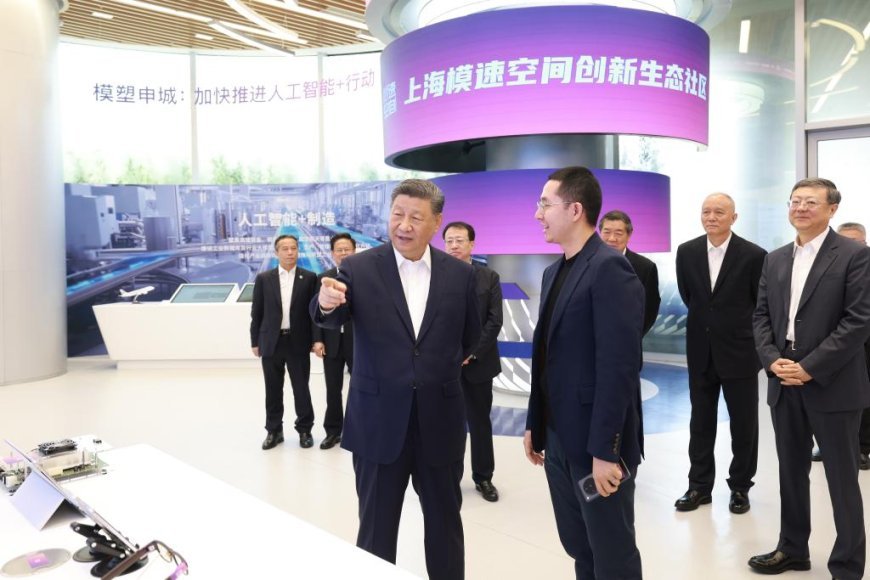
The presence of figures like Lei Jun from Xiaomi and senior officials overseeing embodied AI and robotics highlights another critical evolution, the Chinese private sector is no longer simply tolerated, it is being militarized into national strategy. Entrepreneurs are not being encouraged to disrupt the system, they are being integrated into it, expected to deliver technological breakthroughs as part of China’s collective geopolitical project.
In practical terms, this means China’s tech industry will increasingly resemble a hybrid entity, part commercial enterprise, part state infrastructure, part strategic weapon. Innovation will still exist, but it will operate within boundaries defined by national interest, not consumer demand or global ethics.
Xi’s visits to Shanghai’s AI incubators and Guangzhou’s industrial innovation zones last year already hinted at this trajectory, but 2026 marks the moment it becomes explicit doctrine. China is no longer content to be the world’s factory, it wants to be the world’s operating system.
The deeper implication is that global competition is quietly shifting away from ideology, culture, or even military alliances, toward a far colder metric: who controls the future technologies that structure reality itself. Chips determine weapons, algorithms shape societies, robotics redefine labor, and whoever leads these domains writes the rules everyone else must follow.
Xi understands this better than most Western leaders, who still treat innovation as an economic sector rather than a power structure. China’s approach is not romantic, not liberal, and not particularly free, but it is brutally coherent. Every policy, every visit, every speech feeds into a single objective: making technological dominance synonymous with national survival.
This is why Xi’s first tour of 2026 matters more than it appears. It is not a ceremonial inspection, it is a quiet declaration that China’s next great leap will not be ideological, it will be engineered, and the world is being given early notice whether it is ready or not.
Advertisement