Trade Deficit Hits $1.2 Trillion As Supreme Court Adjusts Trump’s Tariff Settings
The trade deficit climbs to $1.2 trillion as the Supreme Court curbs Trump’s tariff authority, prompting a new 15% import levy under a different law. Allies brace for uncertainty. Markets brace for math.
 Filna
Filna 
Advertisement
The U.S. trade deficit has reportedly decided to participate in the national conversation, widening by 2.1% compared to 2024 and reaching approximately $1.2 trillion — just as the Supreme Court placed meaningful boundaries on President Donald Trump’s tariff authority.
Advertisement
Advertisement
Advertisement
Advertisement
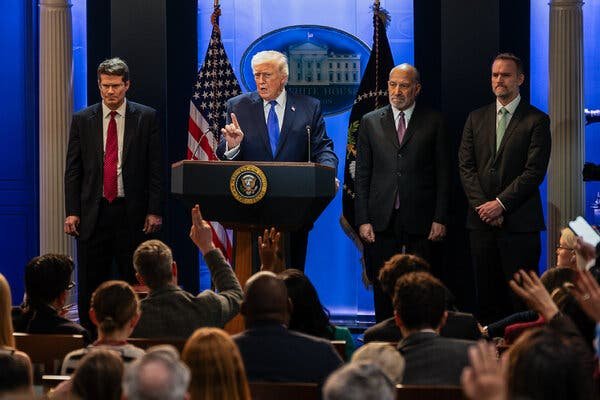
Trump has long framed tariffs as the backbone of his economic vision, arguing they would reduce the trade deficit and incentivize domestic manufacturing. This week, the deficit responded with fresh record highs.
The Supreme Court ruling marked a significant check on presidential power, complicating one of the central planks of Trump’s second-term agenda. But rather than retreat, the administration pivoted.
Under Section 122 of the Trade Act of 1974, most imported goods will now face a 15% tariff. Certain products — including critical minerals, metals and pharmaceuticals — are exempt. Separate tariffs on steel, aluminium, lumber and automobiles remain in place under different legal authorities.
In short, trade policy has entered its customization phase.
Baltimore steel manufacturer Drew Greenblatt called the ruling a setback, arguing it diminishes opportunities for Americans seeking manufacturing jobs. Meanwhile, soybean farmer John Boyd described the decision as a win and declared plainly that the president lost this round.
Trade advisers abroad offered less emotional assessments and more concern about complexity. Allie Renison, a former UK government trade adviser, noted that businesses now face a patchwork system. William Bain of the British Chambers of Commerce warned that the uncertainty could damage trade and weaken global growth.
On Friday, a White House official clarified that countries which had previously negotiated trade deals — including the UK — would now face the global 15% tariff under Section 122, rather than their earlier negotiated rates. However, sector-specific agreements involving steel, aluminium, pharmaceuticals, autos and aerospace remain intact.
France and Germany responded with caution. French President Emmanuel Macron emphasized reciprocity over unilateralism. German Chancellor Friedrich Merz described the uncertainty itself as “poison” to economic stability and pledged to coordinate with EU partners ahead of upcoming discussions with Washington.
So the scoreboard currently reads:
Trade deficit: $1.2 trillion.
Supreme Court: Active.
Tariffs: Recalibrated.
Uncertainty: Exported globally.
The administration maintains that the strategy remains sound.
The courts maintain that limits exist.
Businesses maintain spreadsheets.
And global markets continue adjusting to what increasingly resembles a choose-your-own-tariff adventure.
Free trade, observers note, has not disappeared.
It has simply been reorganized.
Advertisement