UN Security Council Scolds Israel As Trump Prepares ‘Board Of Peace’ To Compete With Entire United Nations
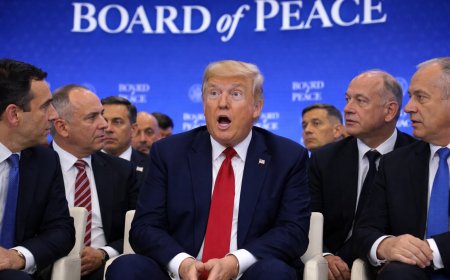
The U.N. Security Council blasts Israel’s West Bank expansion plans as Trump prepares to launch his Board of Peace in Washington. Diplomats warn of annexation. The new board promises action, funding, and possibly competition.
 Filna
Filna 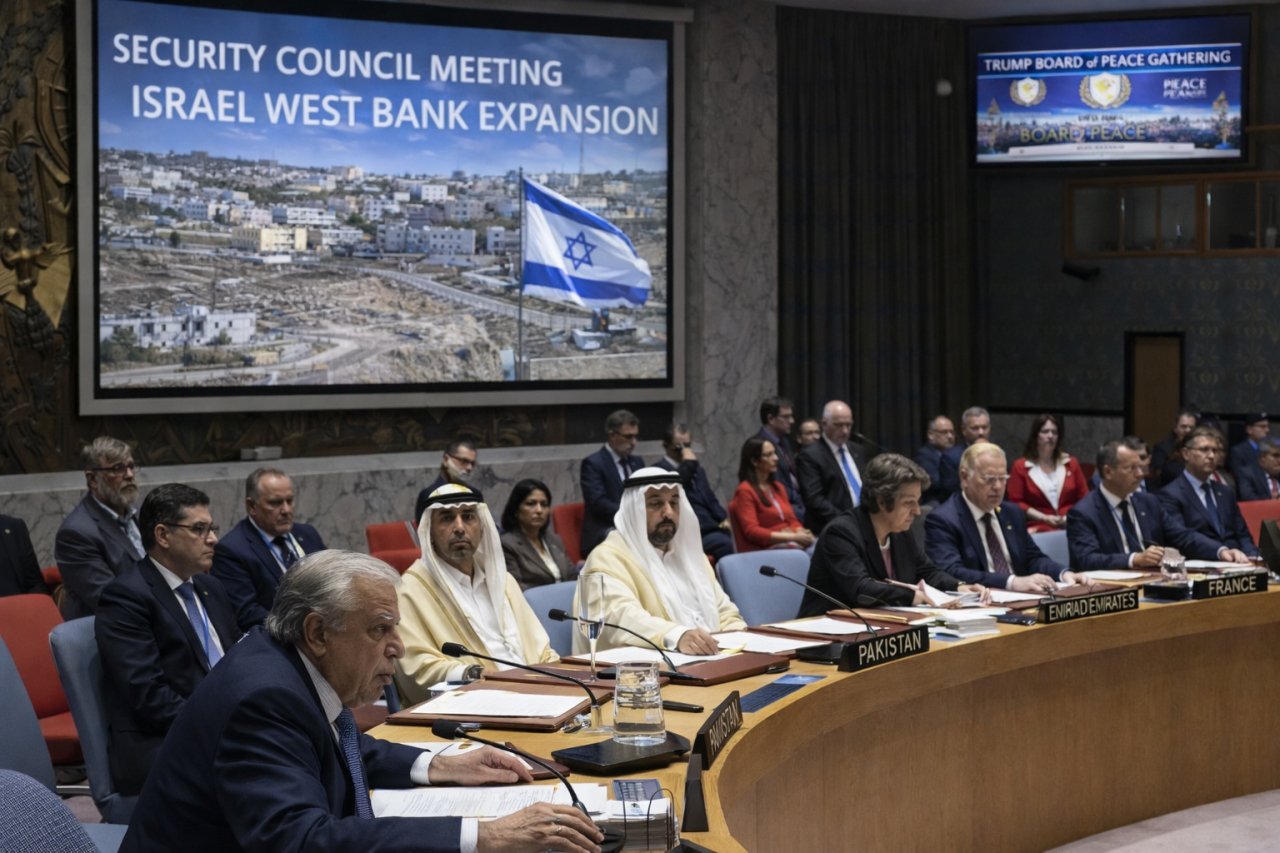
Advertisement
The United Nations Security Council gathered in New York to condemn Israel’s expanding control in the West Bank just hours before President Donald Trump’s inaugural “Board of Peace” meeting in Washington — a scheduling coincidence that diplomatically suggests either urgency or competition.
Advertisement
Advertisement
Advertisement
Advertisement
Security Council members called for the Gaza ceasefire to become permanent and criticized Israeli settlement expansion as a threat to the long-standing two-state solution framework. Pakistan’s foreign minister labeled the West Bank actions “null and void,” while Palestinian representatives described them as a breach of international law and an existential risk to peace efforts.
Israel’s foreign minister responded by accusing the council of harboring an anti-Israeli fixation and emphasized what he described as Israel’s historical claim to the land. He also noted that global attention, in his view, would be directed toward Trump’s Board of Peace rather than the Security Council session.
The Board of Peace, originally framed as a small leadership body overseeing Trump’s 20-point Gaza plan, has since expanded into something more ambitious: a potential mediator for global conflicts. While over 20 countries have accepted invitations, major U.S. allies including France and Germany have opted not to join — instead reiterating support for the United Nations system.
The Security Council meeting itself was rescheduled to avoid travel conflicts once Trump announced his Washington gathering, underscoring the delicate choreography of two institutions seemingly attempting to solve the same crisis through different structures.
Meanwhile, U.N. political leadership warned that the region is at a “pivotal moment,” citing progress under the U.S.-brokered ceasefire that began Oct. 10. Hostage releases have occurred, humanitarian aid has increased, and a technocratic committee now oversees Gaza’s daily administration. Yet major challenges remain: disarming Hamas, deploying international security forces, and reconstructing Gaza’s devastated infrastructure.
Trump stated that Board of Peace members have pledged $5 billion toward reconstruction and committed personnel for stabilization and policing roles. Details remain limited. Indonesia has indicated that thousands of its troops could be ready for potential humanitarian and peace deployment.
At the same time, Israel has advanced a land regulation process in the West Bank that officials describe as deepening control and critics describe as de facto annexation. Palestinians and several Arab states have strongly condemned the move, warning it undermines the viability of a Palestinian state.
So the global scene now features two parallel tracks:
The United Nations, reaffirming international law and long-standing frameworks.
The Board of Peace, promising fresh mechanisms and unconventional action.
One relies on resolutions.
The other promises results.
Whether this is duplication, innovation, or diplomatic rivalry depends largely on who ends up writing the next headline.
For now, both meetings proceed.
Peace, it seems, has a full calendar.
Advertisement